
What New Brunswick Housing Providers Should Include with a Residential Tenancy Application

Updated: 6 days ago
Delays in New Brunswick's residential tenancy system remain a challenge, particularly for disputed claims. While processing times are not entirely within an applicant's control, submitting a complete application with the relevant information and supporting documentation from the outset can help ensure a file is ready to move through the process.
RHPNB recently met with the Tenant and Landlord Relations Office (TLRO) to discuss the challenges currently affecting both housing providers and tenants, including processing delays, communication, consistency in decisions and the overall application process.
During that meeting, TLRO also provided RHPNB with practical guidance on the information and documentation that should accompany common residential tenancy applications. We've compiled that guidance below to help New Brunswick housing providers better prepare their applications before submitting them.

RHPNB Meets with the Tenant and Landlord Relations Office
During its meeting with RHPNB, TLRO acknowledged that processing times remain longer than desired, particularly for disputed claims, which the office indicated are currently taking approximately six months to resolve. TLRO also reported that its backlog has improved significantly over the past year.
While broader improvements to the residential tenancy system remain important, housing providers can do their part by making sure applications are as complete as possible when they are first submitted.
Providing the relevant notices, lease information, proof of service, payment records, photographs, invoices and other supporting documentation at the beginning of the process can give TLRO the information needed to assess the file.
What Should You Include with a Residential Tenancy Application?
Abandoned Belongings / Chattels
When an application involves belongings left behind by a tenant, include:
Photos of all items
A list of the abandoned belongings
The estimated individual value of each item
The amount owing by the tenant
The current location of the belongings
An explanation of how the tenancy ended
Confirmation that an attempt has been made, or will be made, to contact the tenant.
Eviction
For an eviction related application, include:
The Notice to Vacate or Notice of Termination and any previous notices
Lease information and relevant details
Proof of service
Confirmation of whether the tenant remains in the unit
Payment information, including amounts, payment dates and the outstanding balance
Details of previous payment attempts or arrangements
Confirmation if the tenancy involves a mobile home site, where applicable
Any relevant safety concerns, including those involving children, pets or other risks
Security deposit information and proof of remittance
Current tenant contact information
Health and Safety
For an application involving a health or safety concern, include:
Notice of Complaint
Lease information and relevant details
Proof that the issue remains unresolved after the applicable deadline
Landlord Offence
For an application involving an alleged landlord offence, include:
Notice of Complaint
Lease information and relevant details
Proof that the issue remains unresolved
Proof of security deposit payment, if applicable
A letter confirming the deposit is not held in cases involving non-remittance
Landlord Failed Obligation
For an application concerning an unfulfilled landlord obligation, include:
Notice of Complaint
Lease information and relevant details
Proof that the issue remains unresolved after the applicable deadline
Repairs
For a repair related application, include:
Notice of Complaint
Lease information and relevant details
Proof that the issue remains unresolved after the applicable deadline
Above-Guideline Rent Increase
For an above guideline rent increase application, include:
A written statement outlining the work completed
Dates the work was completed
The reasons for the work
Associated costs
The requested rent increase
A description of the premises and services provided
Information about the last rent increase
Property owner contact information
Lease information and relevant details
Request for Compensation
For a compensation claim, include:
Notice of Termination
Lease information and relevant details
Relevant receipts or invoices
An explanation of the compensation being claimed
Termination for Renovations
When requesting to terminate a tenancy to complete renovations, include:
A signed statement outlining the work to be completed
An explanation of why the work is necessary
An explanation of why vacant possession is required
Lease information and relevant details
Supporting documentation, such as permits, plans and quotes
Revision of a Lease Alteration
For a request to review an alteration to a lease, include:
Notice or letter of alteration
Lease information and relevant details
The previous and revised lease, if applicable
Revision of a Termination Notice
For a request to review a termination notice, include:
Notice of Termination
Lease information and relevant details
Revision of a Rent Increase
For a request to review a rent increase, include:
Notice of Rent Increase
Lease information and relevant details
Tenant Failed Obligation
For an application concerning an unfulfilled tenant obligation, include:
Notice of Complaint
Lease information and relevant details
Proof that the issue remains unresolved after the applicable deadline
Breached Compliance Order
If an existing compliance order has been breached, include:
The Compliance Order
Lease information and relevant details
Proof that the order was breached
Form 3
When submitting a Form 3 application, include:
Form 3
Lease information and relevant details
Proof of service
Confirmation of whether the tenant remains in the unit
Property owner information
SCAN officer contact information, if applicable
Before You Submit: Review Your File
Before submitting an application, take a few minutes to review the file against the applicable documentation list.
Ask:
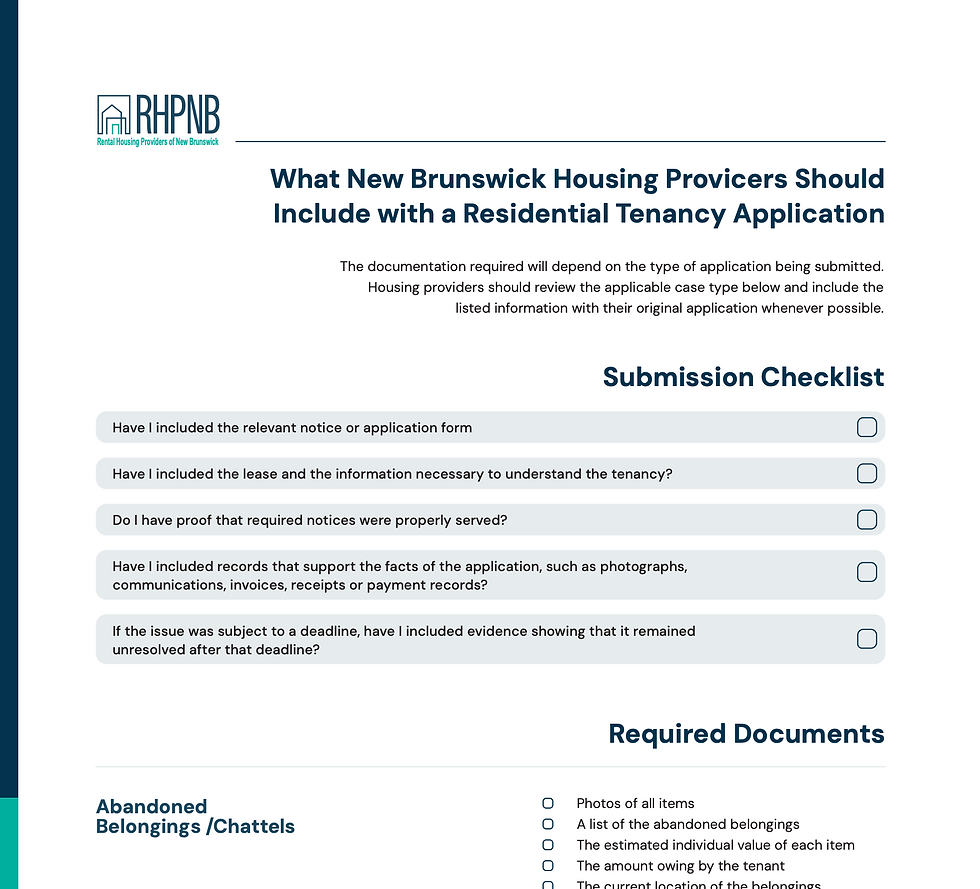
Have I included the relevant notice or application form?
Have I included the lease and the information necessary to understand the tenancy?
Do I have proof that required notices were properly served?
Have I included records that support the facts of the application, such as photographs, communications, invoices, receipts or payment records?
If the issue was subject to a deadline, have I included evidence showing that it remained unresolved after that deadline?
The exact documentation will depend on the type of application. The goal is to provide the relevant information and supporting evidence with the original submission whenever possible rather than waiting for it to be requested later.
What If You Can't Upload All of Your Supporting Documents?
RHPNB was advised that the online application system has limitations on the documents that can be uploaded.
When additional supporting documents cannot be included through the online system, they can be emailed to the Tenant and Landlord Relations Office at HNBIrentSolve@gnb.ca to be added to the file.
When submitting additional documentation, make sure it can be clearly connected to the appropriate application or case.
Improving the Residential Tenancy Process Takes Cooperation
Complete applications are only one part of improving New Brunswick's residential tenancy system.
RHPNB's discussion with TLRO also addressed broader concerns affecting housing providers and tenants, including processing times, communication and consistency in decision-making.
RHPNB will continue working with the Tenant and Landlord Relations Office to raise the concerns experienced by housing providers, improve communication between the industry and the office, and help housing providers better understand and navigate New Brunswick's residential tenancy processes.
In the meantime, housing providers can help make their own applications easier to assess by starting with a well-documented file and providing the relevant supporting information as early in the process as possible.
PREVIEW
Comments